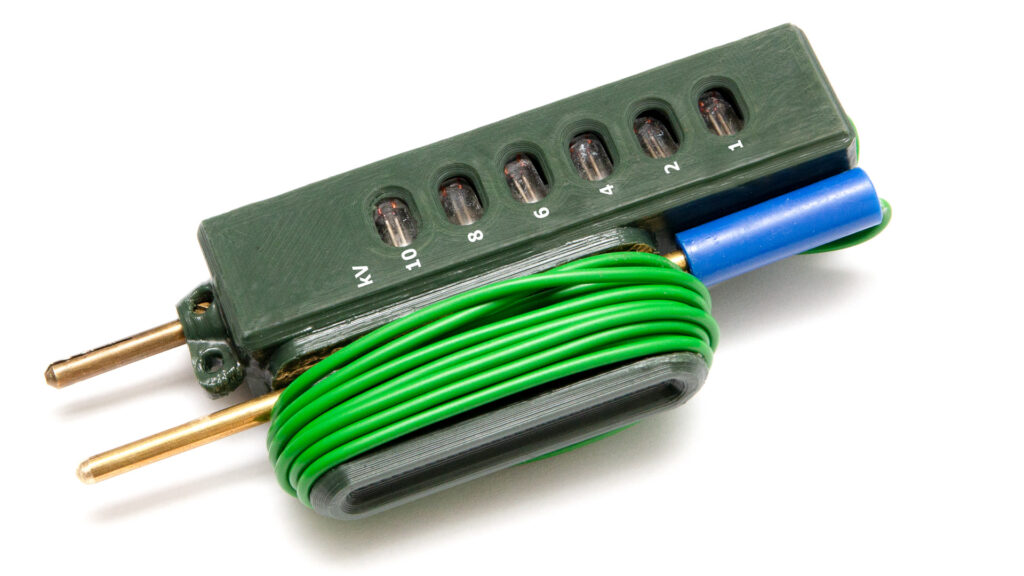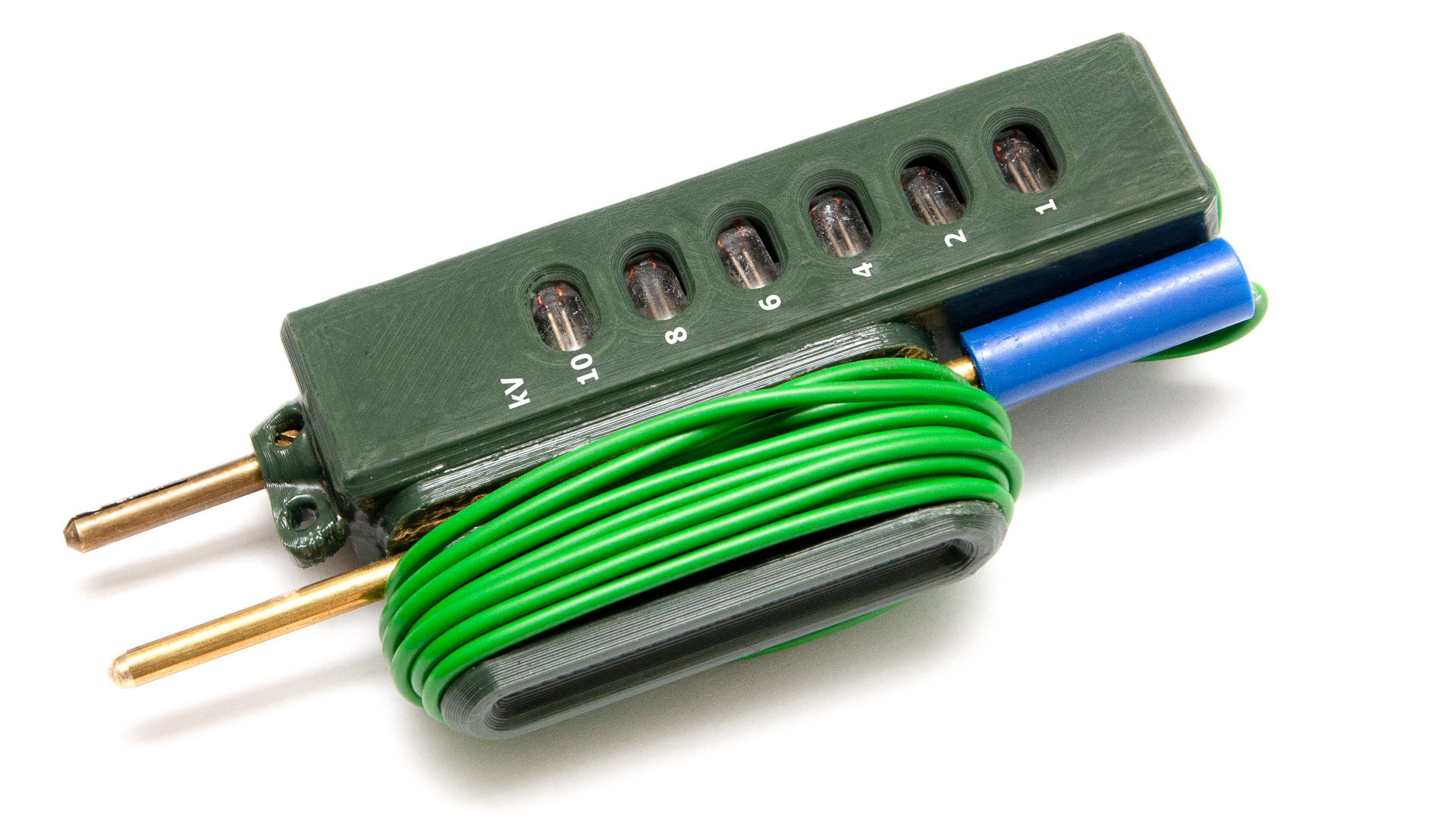
This gadget was basically born as a continuation of the neon lamp project. No, I don’t keep horses or cattle, so I don’t have an electric fence of my own. But when wandering through the woods and fields, I often run into electric fences, and it’s always a bit of a puzzle whether they’re live or not. This little device—barely bigger than a pocketknife—was made to find that out.
The design is extremely simple: a row of neon lamps and a row of resistors. The neon lamps light up when enough voltage drops across their series resistors. Since the resistors all have different values, the lamps light up in sequence depending on the voltage present at the point marked HV:
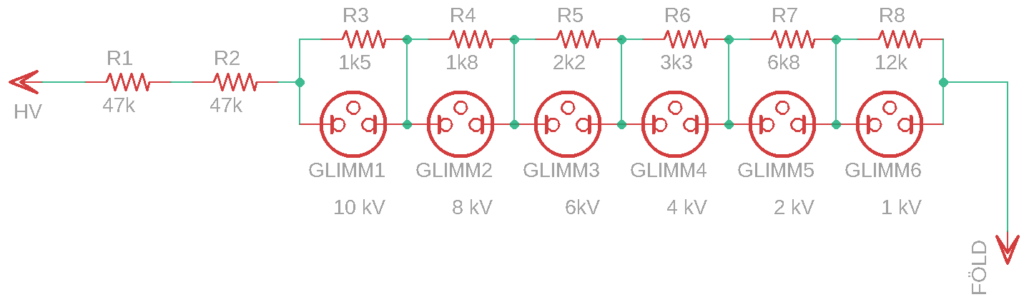
The point marked GROUND (FÖLD) must be connected to earth during measurement. For this, I use a brass rod about 10 cm long, connected to the device with a piece of wire roughly 1.5 m long. This rod should be pushed into the ground.
Warning! This is not a test screwdriver! When in use, the GROUND point must be earthed—do not touch it!
n a standard test screwdriver, there is a 1 MΩ series resistor connected to a neon lamp. The peak mains voltage is 230·√2 = 325 V. Subtracting the lamp’s ignition voltage gives 325 – 125 = 200 V. With the 1 MΩ resistor, the maximum current through your body when you touch the tip is 200 V / 1 MΩ = 0.2 mA.
You won’t even feel this—the threshold for perceiving electric current is around 0.5 mA.
With the electric fence tester, however, the series resistance is only 94 kΩ, about a tenth of that, so if you plug it into the mains, you’ll get a clearly noticeable current of about 2 mA. It’s generally harmless, but you will feel a definite sting. And if you touch it to a multi-kilovolt electric fence, it’s as if the series resistor isn’t there at all!
If the HV tip touches the fence wire while you hold the ground lead, you’ll get zapped just as if you had grabbed the fence directly. The correct procedure is therefore to push the ground spike into the earth first, and only then approach the fence with the HV tip. If you’re testing an electric fence indoors on the kitchen table, you obviously shouldn’t try to stick the spike into the floor tiles—instead, connect it to the fence’s ground terminal.
The circuit is so simple you don’t even need to make a PCB for it—although you can, if you want to.
You could also mount it in something like a toothbrush holder, or 3D-print a suitable case. In my case, the design currently looks like this: