

I came across this interesting device in a Facebook post. The person who shared it didn’t explain what it actually is, and the comments, as usual, were rather uninformative. So I looked it up in Russian sources to find out what it is.
The Soviet space program used completely different controls and instruments from American spacecraft. Soyuz T “Globus” IMP navigational instrument used as a positional indicator to display the spacecraft’s location relative to Earth in Soviet and Russian crewed spacecraft. Measuring 11.5″ x 8″ x 5.5″, manufactured in 1967. A mechanical computer that functioned in essentially unchanged form from Gagarin’s first spaceflight all the way until its retirement in 2002(!). Just for context: five years later, in 2007, Steve Jobs introduced the first generation of the iPhone.
The impressive electro-mechanical device incorporates hundreds of mechanical components common to horology in order to move the three-dimensional terrestrial globe displayed at the center. Throughout the whole flight, the globe would move beneath the crosshair etched on its transparent cover, mirroring the apparent movement of Earth under the spacecraft. The latitude and longitude are indicated above and beside the globe, and initial orbit parameters were preset using the knobs on the faceplate. Numbered bullets affixed to the globe indicate communications stations.
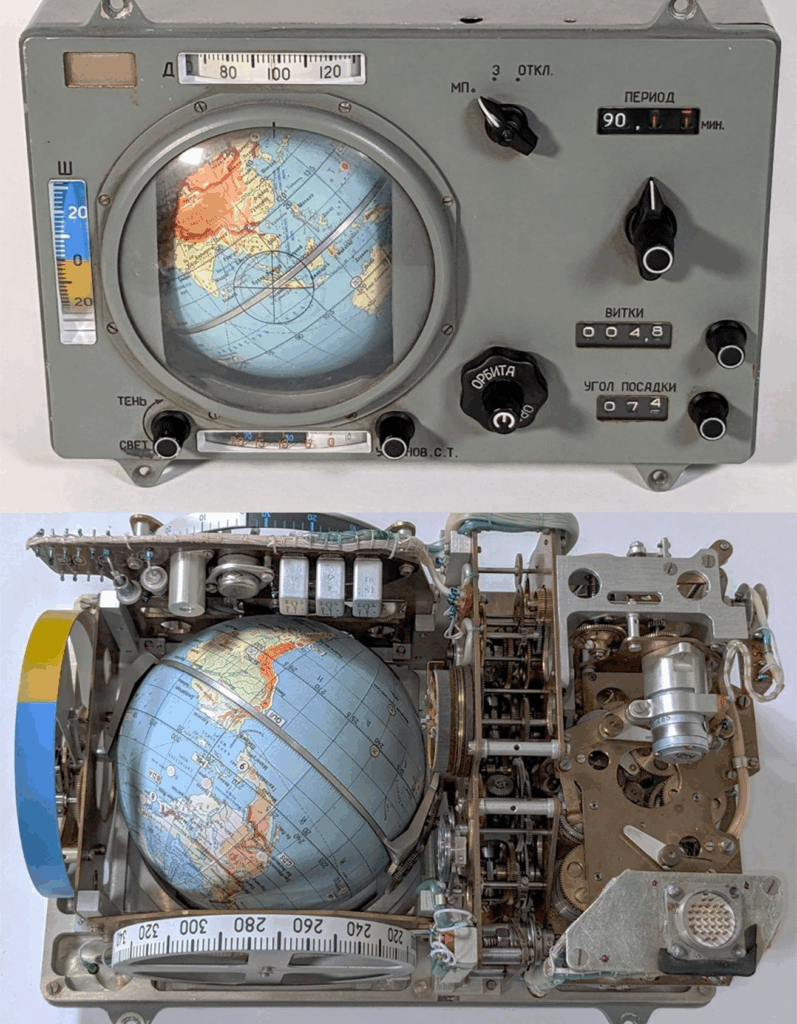
This engineering creation was one of the first true decision-support tools, performing forecasts with adjustable input parameters. Particularly interesting is that by turning the mode selector switch, the cosmonauts could, within a certain margin of error, obtain a projection of the the intended place of landing of the ship when the braking propulsion system (TDU) is switched on at the moment. In addition to displaying the location of the spacecraft, the Globus IMP is designed to provide the cosmonaut with: the number of revolutions around the Earth made since entering the orbit; radio visibility zones of HF and VHF radio stations; and the time remaining before entering or leaving the shadow.
On the CuriousMarc YouTube channel, they present the device in detail in a two-part film:
Prior to launch, latitude and longitude were adjusted to the precalculated coordinates of entering orbit. Right after the launch phase, once the orbit was established, its parameters were precisely measured by radar and radio telemetry from the ground. Revised settings for the IMP were then computed on the ground and communicated to the crew, which reset the instrument’s three orbital Correction parameters, the equatorial longitude and the present point in the orbit using the Э knob and the ОРБИТА knob. After this, the cosmonauts toggled the activation switch on.
This last action connected the flight sequencer system’s impulses to the instrument’s solenoid actuator. These impulses were then converted into a slow, regular mechanical advance which cascaded through the mechanical components, effecting the computations needed to move the globe and other indicators. Meanwhile, the instrument’s variable resistor and cam-activated electric blade contacts modulated electrical signals from other electrical instruments through the spacecraft and its control systems, feeding them with an analog representation of the spacecraft’s displacement relative to Earth coordinates. Some uncommon, intricate horological devices found in the IMP include cardioid-shaped cam discs, a cone-shaped cam cylinder with a cardioid cross-section and “mechanical rectifiers” which transformed an alternating motion into an analogous, but unidirectional motion.
Like most of early spacecraft’s cockpit instruments, the IMP Globus was designed and tested to remain operative in a complete vacuum, in case of an accidental depressurisation of the cabin. The IMP was a genuine mechanical computer.