
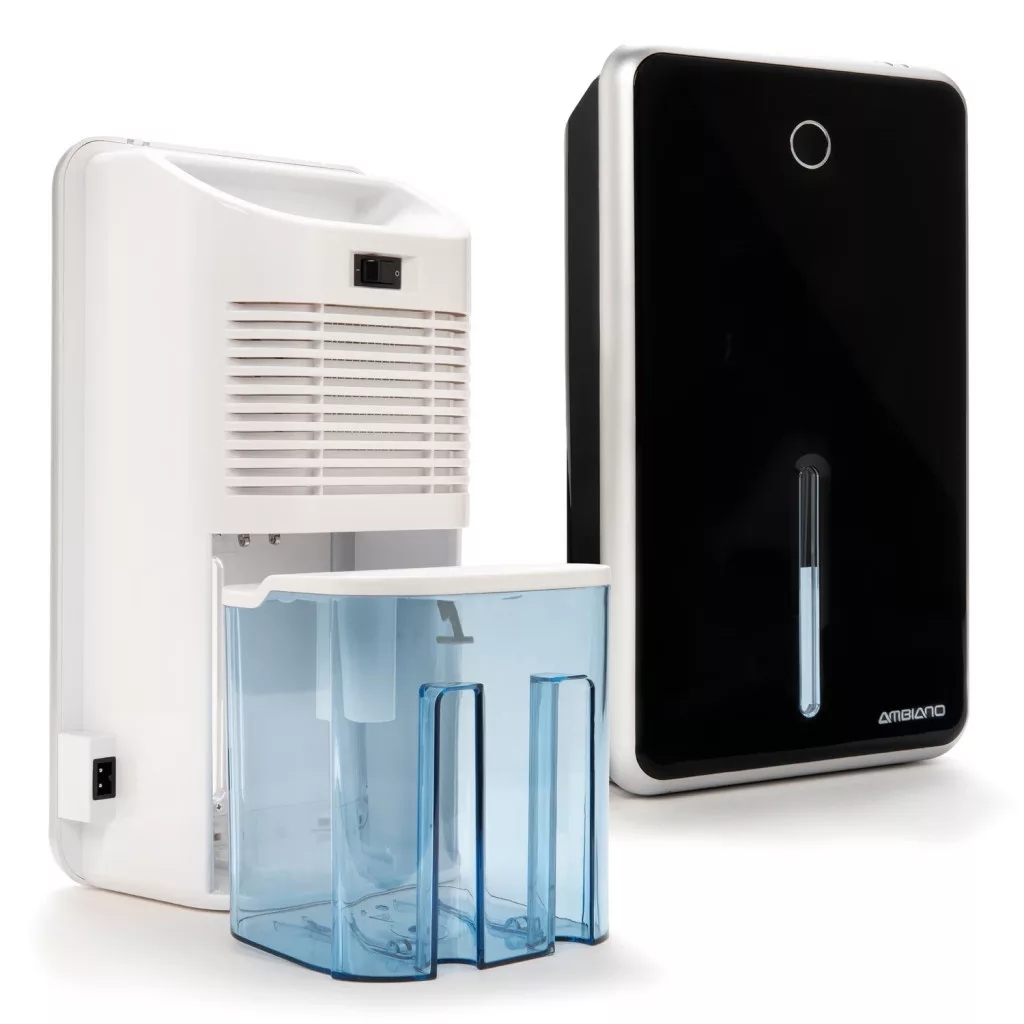
This device was sold in Hungary by ALDI and eMAG, among others, for €8–9, but I have also seen it in foreign online stores priced between €10 and €25. It is a Peltier-element dehumidifier, which in principle removes water from the air by cooling it so that the moisture condenses and drips into the tank. Let’s see what it’s good for, and whether it’s worth the price.
The unit was marketed under the model designation Ambiano GT-SF-KLE-01 as well as Easy Home DH-2015 – both are the same device. It was available in black, white, and metallic gray. Its design is interesting, as if it were made to be built into some kind of door – perhaps the designer intended it for a cabinet?
The device runs on 12V. It comes with an external switch-mode power supply, the same type as those typically used for LED light strips, except with a different 12V connector. There is a serious problem with this connector that can make using the device dangerous: it may catch fire. It is no coincidence that there is a label on the cord, printed in red letters, strongly warning that the plug must be pushed in all the way with force until it locks. You may think you have plugged it in properly, but you haven’t. And if it only makes partial contact, the contact resistance causes strong heating, which can melt and ignite it. If you press it all the way in with full force, it works, though it still gets slightly warm (which is not good for a connector—especially in 24-hour unattended operation).
Technical data
- Dehumidification capacity: 400 ml/day (30°C, 80%)
- Power supply: 230V / 50Hz
- Rated power consumption: 65 W (30°C, 80%)
- Rated current: 0.5 A
- Touch control: yes
- Water tank capacity: 1.5 liters
- Noise level: 35 dB(A)
- Ideal room size: 10 m²
- Effective for rooms up to 15 m²
- Airflow: 7 m³/hour
- Power cord length: 3.2 meters
- Drainage method: water tank
- Net weight: 2.3 kg
- Product dimensions: 205 × 125 × 350 mm
- Automatic shut-off when water tank is full
What’s under the casing?
On the @bigclivedotcom YouTube channel there’s a video where the device is taken apart and its insides are shown. It’s a rather primitive construction. Inside, there is a TEC1-12705 ceramic-encased Peltier element mounted on an aluminum heatsink. A small fan blows the room air through the fins of the heatsink, cooling it there so that moisture condenses on the fins and drips into the tank.
How a Peltier Chip Works
A Peltier chip, or thermoelectric cooler (TEC), is a solid-state device that can move heat from one side to the other when an electric current passes through it. The TEC1-12705, for example, is a common 12-volt, 4-ampere module with a nominal power rating of about 48 watts.
Its operation is based on the Peltier effect, discovered in 1834: a temperature difference develops across the junctions of two different semiconductors when current flows. A Peltier chip is essentially a sandwich of many tiny semiconductor “thermocouples” connected electrically in series and thermally in parallel, sealed between two ceramic plates.
When direct current is applied, one side of the chip absorbs heat (becomes cold) while the other side releases it (becomes hot). If the current is reversed, the hot and cold sides swap. Because of this, a Peltier device can be used for both cooling and heating.
However, efficiency is low compared to conventional refrigeration: most of the input electrical energy ends up as additional heat on the hot side. To work effectively, a Peltier chip requires good thermal management—usually a heatsink and sometimes a fan—to dissipate the heat from the hot side. Without proper cooling, the temperature difference quickly collapses, and the chip overheats.
Despite their inefficiency, Peltier modules are popular in small appliances, CPU coolers, portable fridges, and dehumidifiers, because they are compact, have no moving parts, and can provide precise electronic control of temperature.
The COP (Coefficient of Performance) of a Peltier module tells us how efficiently it moves heat compared to the electrical power it consumes. The TEC1-12705 can pump ~40–45 W of heat from the cold side. Under optimal conditions (ΔT between hot and cold sides ≈ 0–15 °C), it gives a COP ≈ 0.8–0.9. But the useful performance drops sharply as the temperature difference increases. At ΔT ≈ 30 °C, the pumped heat is only ~15–20 W for the same 48 W input, then the COP falls to ≈ 0.3–0.4. Near the maximum ΔT (around 65 °C), COP may drop below 0.1. Typical COP in gadgets: ~0.3–0.5 – ompared to compressor refrigerators (COP 2–4). Peltier devices are much less efficient, but simpler, quieter, and smaller.
What can you use this device for?
The creator of the above video, Clive Mitchell (a Scottish electronics hobbyist and instrument maker) writes:
„I ran this unit in my cold house for three hours and it formed frost on the condenser fins which only dripped off when the unit was turned off. If you need a dehumidifier and have a warm house I recommend getting a traditional compressor type dehumidifier as they will pay their way quickly with very efficient and fast extraction of water from the air If you need to use a dehumidifier in a cold location then the best type is a desiccant drum dehumidifier, which uses a rotating drum of desiccant material to absorb moisture and then extract it again with heat. They will pull out a lot of water in cold areas, and also put out a stream of dry warm air. I use both types. Compressor in the summer and desiccant drum in the winter. Another valid option for reducing humidity in cool areas is ventilation. Particularly if you use a humidity controlled fan.”
I completely agree with this. I also took my own measurements, and I tested the device myself and found the same: the aluminum heatsink frosts up, while the unit extracts barely a few drops of water from the air. It is essentially unsuitable for effectively reducing the humidity of a room—whether a bedroom, bathroom, or office, or even inside a wardrobe.
A bit of building physics
How much water vapor is produced during an average shower? To find out, we need to do some calculations—let’s go step by step!
Water consumption of an average shower
- Water-saving shower: approx. 7–9 liters/minute
- Traditional shower: approx. 12–15 liters/minute
So, for an 8–10 minute shower: 60–120 liters of water are used.
How much of this evaporates?
100 liters of shower water × 0.5% = 0.5 liters of water = 500 ml of water vapor.
This amount is about 0.5 kg of water, i.e. roughly 12 mol of water, which in gaseous state corresponds to about 270 liters of water vapor at normal pressure!
The air in a 6–8 m² bathroom quickly becomes saturated with this amount, and the relative humidity approaches 100%. That is why condensation appears on tiles, mirrors, and windows.
So, during an average shower, about half a liter of water equivalent in vapor enters the air—but from the perspective of the room, this represents a huge moisture load. It would be desirable to remove this vapor from the air, but can this device do that?
The Easy Home DH-2015 dehumidifier has a nominal performance of 400 ml/day, meaning that in 24 hours of continuous operation, it could theoretically remove only 80% of the moisture produced during a single shower. So the answer is: no.
Conclusion
The Easy Home DH-2015 is not suitable for bathroom use. It cannot even cope with the amount of steam produced during a single shower. For this purpose, you need a fan, proper ventilation, or a much more powerful dehumidifier (e.g., with a capacity of 10–20 liters per day).
Then what is it good for? For example, it can be taken apart and used to study how a Peltier cooler works.